
Search is changing.
People are no longer relying exclusively on traditional search engine results pages to find businesses, products, services, and answers. AI-powered search experiences are increasingly becoming part of how users discover and evaluate information.
This shift creates a new opportunity for businesses: becoming visible not only in traditional search results, but also in the answers generated by AI systems.
That is where technical optimisation for GEO comes in.
Generative Engine Optimization (GEO) focuses on improving the way your website and brand are understood, interpreted, and referenced by AI-powered search and answer engines.
But GEO isn’t simply about adding a few keywords or creating more AI-generated content.
Your website needs a strong technical foundation, clear information architecture, accessible content, structured data, trustworthy signals, and a consistent digital presence.
For businesses targeting the UK market, preparing for AI search now can help establish stronger digital visibility as search behaviour continues to evolve.
What Is Technical Optimisation for GEO?
Technical optimisation for GEO refers to the technical and structural improvements that help AI-powered search systems discover, crawl, interpret, and understand the information available on your website.
Traditional SEO focuses heavily on improving visibility in search engine results.
GEO expands the focus toward how information can be understood and potentially surfaced within generative search experiences.
Technical GEO can involve:
- Website crawlability
- Indexability
- Structured data
- Semantic HTML
- Clear website architecture
- Entity identification
- Internal linking
- Content accessibility
- Page performance
- Author and business information
- Consistent brand information
- Machine-readable website signals
The objective is not to “trick” AI systems into mentioning your business.
Instead, the goal is to make your website clear, accessible, credible, and easy for search systems to understand.
Why Does GEO Matter for UK Businesses?
AI-powered search is changing how users interact with information.
Instead of clicking through multiple websites, users may increasingly ask conversational questions and expect a direct answer.
For example:
“What’s the best digital marketing agency for a growing ecommerce business in London?”
A traditional search may return a list of websites.
An AI-powered experience may provide a summarised response and reference or recommend specific businesses.
This creates a new visibility opportunity.
Businesses need to consider not only:
“How do we rank?”
but also:
“How clearly does the web understand what our business does, who we serve, and why we are credible?”
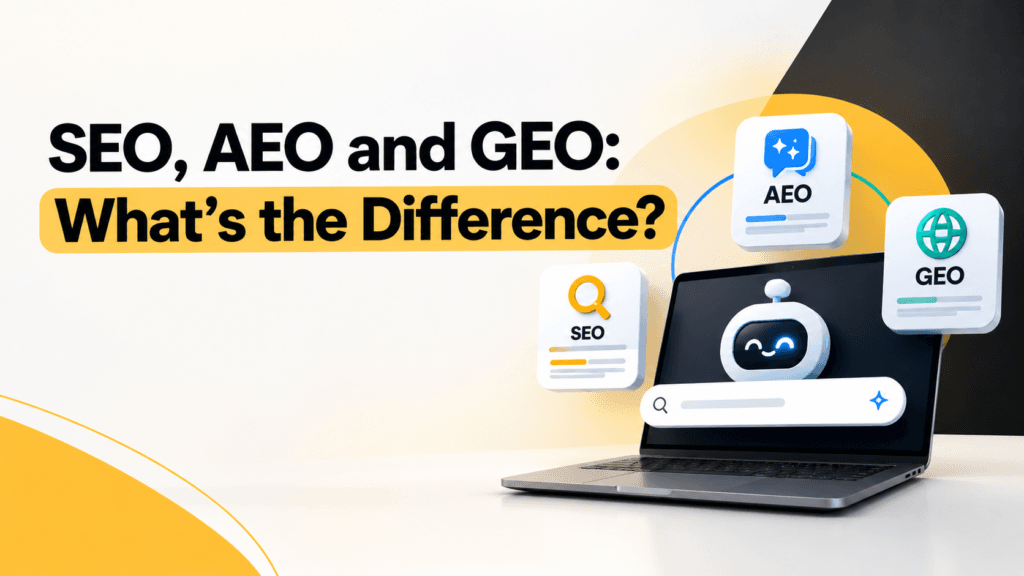
SEO, AEO and GEO: What’s the Difference?
These three concepts overlap, but they have different primary focuses.
| Approach | Primary Focus | Typical Outcome |
|---|---|---|
| SEO | Search engine visibility | Organic rankings |
| AEO | Answer-focused search | Featured answers and snippets |
| GEO | Generative search visibility | AI-generated responses and citations |
A strong modern search strategy shouldn’t necessarily choose one over another.
SEO creates the foundation. AEO improves the ability to answer specific queries. GEO considers visibility within generative search experiences.
Together, they create a more comprehensive search strategy.
Technical Foundations for GEO
1. Make Your Website Easy to Crawl
Before AI systems can understand your content, they need access to it.
Your website should have a technically sound foundation that allows search crawlers to discover important pages.
Review:
- Robots.txt
- XML sitemaps
- Internal links
- HTTP status codes
- Redirects
- Canonical tags
- Crawl depth
- Orphan pages
Important commercial pages shouldn’t be buried several levels deep within the website.
2. Improve Website Architecture
A clear website structure helps both humans and machines understand how your information is organised.
For example, an agency website might structure its content around:
Services → SEO → Technical SEO
Services → Digital Marketing → PPC
Services → Website Development → WordPress Development
This creates clear relationships between topics and helps establish topical context.
A logical architecture is particularly important for larger websites with hundreds or thousands of pages.
3. Use Structured Data
Structured data provides machine-readable information about the content of a webpage.
Depending on the page, relevant schema types may include:
- Organization
- LocalBusiness
- Service
- Product
- Article
- FAQ
- BreadcrumbList
- Review
Structured data doesn’t guarantee that your content will appear in AI-generated answers.
However, accurate structured data can provide additional context about entities and page content.
It should therefore be treated as part of a broader technical SEO and GEO strategy.
4. Strengthen Entity Signals
AI search relies heavily on understanding entities and relationships.
Your business should have consistent information across the web.
Important entity signals can include:
- Business name
- Services
- Locations
- Founders
- Industry
- Contact information
- Social profiles
- Company profiles
- Relevant publications
- Author information
For example, if your business name, service descriptions, and location information vary significantly across different websites, it can make your online identity less consistent.
Consistency helps establish a clearer digital footprint.
5. Build Strong Internal Linking
Internal links do more than help users navigate your website.
They also establish relationships between pages.
Suppose your website has a main page about SEO services and supporting content about:
- Technical SEO
- Ecommerce SEO
- Local SEO
- SEO audits
- Keyword research
Linking these pages strategically creates a stronger topical relationship.
Instead of isolated articles, you create a connected information ecosystem.
6. Make Important Content Accessible
Some websites hide important information behind:
- JavaScript-heavy interfaces
- Interactive components
- Login requirements
- Poor navigation
- Images containing essential text
Important information should be available in crawlable, readable HTML wherever practical.
This is particularly important for:
- Service descriptions
- Business information
- Product details
- Author information
- FAQs
- Pricing information
- Contact information
If important information is difficult for systems to access or interpret, you create unnecessary barriers to visibility.
7. Improve Page Performance
Performance remains an important part of a technically strong website.
Review:
- Core Web Vitals
- Mobile responsiveness
- Image sizes
- JavaScript
- CSS
- Server response time
- Caching
- Hosting configuration
Performance optimisation shouldn’t be approached simply as a score-chasing exercise.
The goal is to provide a fast, stable, accessible experience for real users while maintaining a technically healthy website.
Technical GEO and Content Structure
Technical optimisation alone isn’t enough.
The content itself needs to be structured in a way that clearly answers user questions.
Instead of writing a 2,000-word page filled with vague statements, structure information around clear questions and entities.
For example:
What is technical SEO?
Provide a concise definition.
Why is technical SEO important?
Explain the business impact.
What does a technical SEO audit include?
List the major components.
How can businesses improve technical SEO?
Provide practical recommendations.
This approach makes content easier to scan, understand, and extract.
Create Content Around Real Questions
Generative search is conversational.
Users may ask:
- What is the best SEO agency for a small business?
- How much does SEO cost in the UK?
- Which WordPress platform is best for ecommerce?
- How can I improve my website rankings?
- What should I look for in a digital marketing agency?
Your content should address these questions naturally.
This doesn’t mean creating hundreds of pages for every possible question.
Instead, identify the questions that genuinely matter to your customers and create authoritative resources around them.
Demonstrate Expertise and Trust
AI visibility shouldn’t be pursued separately from credibility.
Businesses should demonstrate why their information deserves attention.
Useful trust signals include:
- Experienced authors
- Author biographies
- Company information
- Original research
- Case studies
- Clear contact details
- Transparent service information
- Client results where substantiated
- Relevant industry experience
- Accurate references
For example, a digital marketing agency can demonstrate expertise through detailed case studies showing the challenge, strategy, implementation, and measurable outcome.
That is considerably stronger than simply claiming to be a “leading agency.”
Original Data Can Strengthen Your Digital Footprint
One of the most valuable ways to build authority is to publish information that others don’t have.
This could include:
- Original research
- Industry surveys
- Campaign insights
- Performance benchmarks
- Expert commentary
- Case studies
- Proprietary data
When other websites reference this information, your business can gain additional authority signals and visibility across the wider web.
GEO for Local UK Businesses
Local businesses should pay particular attention to entity and location signals.
Your website should clearly communicate:
- Business name
- Physical location where applicable
- Service areas
- Contact information
- Opening hours
- Services
- Local relevance
Consistent information across your website and reputable business directories can strengthen local visibility.
For example, a London-based professional services company should make it immediately clear what it does, who it serves, and where it operates.
GEO for Ecommerce Businesses
Ecommerce websites have additional considerations.
Product and category information should be:
- Clearly structured
- Easily accessible
- Consistent
- Descriptive
- Supported by relevant structured data
Important product attributes shouldn’t exist only inside images or complex interactive elements.
For large ecommerce websites, technical optimisation should also address:
- Faceted navigation
- Duplicate URLs
- Product variants
- Pagination
- Canonicals
- Category architecture
- Internal linking
GEO for B2B Businesses
B2B businesses often have highly specialised products and services.
This creates an opportunity to build authority around specific topics.
A B2B website can strengthen its digital footprint through:
- Industry-specific guides
- Technical documentation
- Case studies
- Expert articles
- Service pages
- Comparison content
- Customer use cases
The more clearly a business demonstrates its expertise, the easier it becomes to understand its position within a particular industry.
Can AI-Generated Content Improve GEO?
AI can assist with content research, outlining, analysis, and production workflows.
But publishing large volumes of generic AI-generated content is not a substitute for expertise.
Businesses should prioritise:
- Original insights
- Human review
- Accurate information
- First-hand experience
- Useful examples
- Expert commentary
- Strong editorial standards
The objective should be better information, not simply more information.
Common Technical GEO Mistakes
Businesses preparing for AI search should avoid several common mistakes.
Creating Content Only for AI
Content should ultimately serve people and genuine search intent.
Publishing Large Amounts of Generic Content
More pages don’t automatically mean more visibility.
Ignoring Traditional SEO
GEO doesn’t replace technical SEO, content quality, authority, or user experience.
Using Inaccurate Structured Data
Schema should accurately represent the content on the page.
Inconsistent Business Information
Different business names, services, addresses, or descriptions across platforms can weaken entity clarity.
Focusing Only on AI Mentions
AI-generated answers can change. Businesses should build durable digital assets rather than chasing individual mentions.
How Veeswarm Approaches GEO
At Veeswarm, we view GEO as an evolution of a broader search and digital visibility strategy.
Our approach combines:
- Technical SEO
- Content strategy
- Entity optimisation
- Structured data
- Website architecture
- Internal linking
- Digital PR and authority building
- Conversion optimisation
- AI search visibility considerations
Rather than creating a separate “AI page” and hoping for visibility, we focus on strengthening the underlying digital ecosystem.
This creates a stronger foundation for traditional search, answer engines, and emerging generative search experiences.
How to Start Technical Optimisation for GEO
Businesses don’t need to rebuild their entire website overnight.
Start with a practical audit.
Step 1: Audit Technical SEO
Identify crawlability, indexing, performance, and architecture problems.
Step 2: Review Entity Signals
Check whether your business information is consistent across important digital properties.
Step 3: Analyse Content
Identify important topics, unanswered customer questions, content gaps, and outdated information.
Step 4: Improve Structured Data
Implement relevant schema accurately where appropriate.
Step 5: Strengthen Internal Links
Connect related content and important commercial pages.
Step 6: Build Authority
Create original resources, case studies, research, and genuinely useful content.
Step 7: Monitor Search Visibility
Track organic search performance and monitor how your brand appears across emerging search experiences.
Is GEO a Replacement for SEO?
No.
GEO should be viewed as complementary to SEO rather than a replacement.
A technically strong website with authoritative content, clear entities, strong internal linking, and excellent user experience provides a solid foundation for multiple forms of search visibility.
Businesses should therefore avoid abandoning proven SEO practices in favour of chasing every new AI search trend.
The Future of Search Is Becoming More Conversational
Search behaviour is evolving, but one principle remains consistent:
Businesses that provide clear, useful, trustworthy information are better positioned to earn visibility.
Technical optimisation for GEO helps ensure that your website’s information is accessible, structured, and understandable within an increasingly AI-driven search ecosystem.
For UK businesses, now is a good time to evaluate whether your digital presence is ready for this shift.
Prepare Your Business for AI Search
AI search is changing how customers discover information—and businesses need to adapt.
Veeswarm can help you assess your website’s technical foundations, content structure, entity signals, and broader search visibility opportunities.
Get a Free Audit & Consultation
Discover where your website can improve and build a stronger digital foundation for search, AI discovery, and long-term online growth.
FAQs
What is technical optimisation for GEO?
Technical optimisation for GEO involves improving a website’s technical structure, accessibility, architecture, structured data, and entity signals so AI-powered search systems can better discover and understand its information.
Is GEO the same as SEO?
No. SEO primarily focuses on improving visibility in traditional search engines, while GEO considers visibility within generative AI-powered search and answer experiences. The two strategies can work together.
Does structured data help with GEO?
Accurate structured data can provide search systems with additional context about a website’s content and entities. However, structured data alone does not guarantee visibility in AI-generated answers.
How can a business prepare for AI search?
Businesses can start by improving technical SEO, creating authoritative content, strengthening entity signals, implementing accurate structured data, improving internal linking, and maintaining consistent information across the web.
Can AI-generated content help a website appear in AI search?
AI can support content research and production, but generic AI-generated content is not a substitute for expertise and originality. Businesses should focus on accurate, useful, experience-based information.
Does GEO replace traditional SEO?
No. Traditional SEO remains an important foundation. Technical health, quality content, authority, user experience, and strong website architecture can support visibility across multiple search environments.