
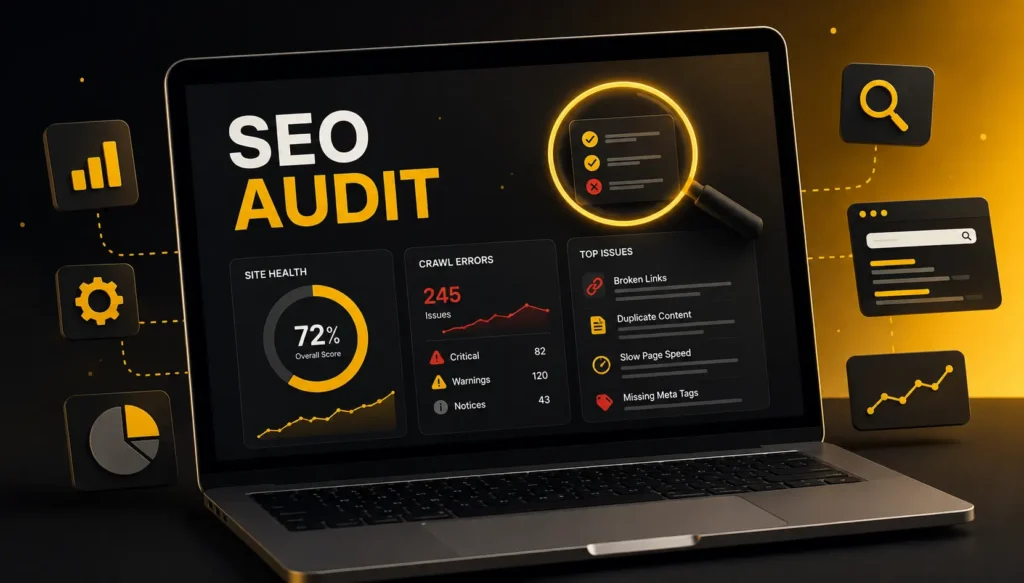
Your website may have great products, valuable content, and a professional design—but that doesn’t necessarily mean Google can find, understand, or rank it effectively.
Technical problems, poor site architecture, weak content, indexing issues, and missed keyword opportunities can quietly hold a website back.
This is why SEO audit services are an important part of any serious search strategy.
Get a Free Audit and Consultation
Discover growth opportunities, identify performance gaps, and get expert insights tailored to your business goals.
An SEO audit examines the factors affecting your website’s search visibility and identifies what needs to be improved. More importantly, it turns SEO from guesswork into a prioritised action plan.
For UK businesses competing for valuable search traffic, a comprehensive audit can reveal opportunities that are difficult to spot from the surface.
At Veeswarm, we use SEO audits to uncover technical, content, structural, and performance issues so businesses can build a stronger foundation for sustainable organic growth.
What Are SEO Audit Services?
SEO audit services involve a detailed evaluation of a website to identify factors that may be affecting its visibility, rankings, organic traffic, and user experience.
A professional audit typically examines:
- Technical SEO
- Website architecture
- Crawlability and indexability
- On-page optimisation
- Keyword targeting
- Content quality
- Internal linking
- Mobile usability
- Page performance
- Structured data
- Backlink profile
- Competitor opportunities
The objective isn’t simply to produce a long list of errors.
A useful audit should explain what is wrong, why it matters, how it should be fixed, and which issues should be prioritised first.
Why Does Your Website Need an SEO Audit?
SEO performance can decline even when you haven’t made major changes to your website.
A new competitor may enter the market. Search behaviour can change. Your website may accumulate technical issues. Old content can become less relevant.
Sometimes, the problem is more basic: your website was never properly optimised in the first place.
Signs that your website may need an audit include:
- Organic traffic has dropped
- Important pages are not ranking
- Rankings have plateaued
- Google isn’t indexing key pages
- Website pages load slowly
- Your content targets the wrong keywords
- Multiple pages compete for the same search terms
- Your website has poor mobile usability
- Organic leads or sales are declining
A comprehensive seo website audit service can help identify the underlying causes rather than treating individual symptoms.
7 Ways SEO Audit Services Can Improve Your Rankings
1. Identify Technical Issues Holding Your Website Back
Technical SEO forms the foundation of search visibility.
Search engines need to crawl, interpret, and index your website efficiently. If technical problems interfere with that process, even high-quality content may struggle to perform.
A technical SEO audit service can uncover issues such as:
- Broken links
- Incorrect redirects
- Crawl errors
- Indexing problems
- Duplicate pages
- Canonicalisation issues
- XML sitemap problems
- Robots.txt misconfigurations
- Poor URL structures
- Mobile usability issues
Fixing these problems can make it easier for search engines to access and understand your website.
2. Improve Website Structure and Internal Linking
Your website structure affects both users and search engines.
Important pages should be easy to discover, logically organised, and connected through relevant internal links.
An audit can identify:
- Orphan pages
- Excessively deep pages
- Weak internal linking
- Poor category structures
- Unclear navigation
- Duplicate or competing pages
A stronger architecture helps distribute internal authority and creates a clearer path through your website.
For ecommerce businesses, this can be particularly important when dealing with large numbers of product and category pages.
3. Discover Keyword and Content Gaps
Ranking isn’t only about having more content.
It’s about creating the right content for the right search intent.
An audit can reveal whether your website is targeting valuable keywords and whether competitors are covering topics that you’ve missed.
For example, a UK professional services company may have a homepage targeting a broad term such as “business consultancy” while competitors have dedicated pages targeting specific commercial searches.
A content-focused audit can uncover opportunities for:
- New service pages
- Location pages
- Supporting blog content
- Comparison pages
- FAQ content
- Long-tail keywords
- Commercial search terms
This creates a more comprehensive topical strategy.
4. Find On-Page SEO Problems
Small optimisation issues can affect how search engines interpret your pages.
SEO auditing services can review:
- Page titles
- Meta descriptions
- Heading structure
- Keyword relevance
- Image optimisation
- URL structure
- Internal links
- Content depth
- Search intent alignment
For example, if your page title is vague while competitors have clear, intent-focused titles, you may be missing an opportunity to improve both relevance and click-through rates.
On-page optimisation should always serve the user first rather than forcing keywords into every sentence.
5. Improve Website Performance and User Experience
Search visibility and user experience are increasingly interconnected.
A slow, difficult-to-use website can frustrate visitors and reduce conversions, particularly on mobile devices.
An audit may identify:
- Slow-loading resources
- Oversized images
- Poor mobile layouts
- Layout instability
- Unnecessary scripts
- Rendering problems
Improving performance can create a better experience for users while supporting stronger technical foundations.
The goal isn’t to chase a perfect technical score simply for its own sake. Performance improvements should contribute to a faster, more usable website.
6. Identify Competitor Opportunities
A good audit shouldn’t look only inward.
Your competitors can reveal important opportunities.
Competitor analysis can uncover:
- Keywords competitors rank for
- Content topics they cover
- Pages generating visibility
- Gaps in your content
- Potential link opportunities
- Structural differences
- Search intent opportunities
For instance, if three direct competitors have dedicated pages for a specific high-intent service while your website doesn’t, that gap may represent an important growth opportunity.
This turns an SEO audit into a strategic roadmap rather than a technical checklist.
7. Prioritise the Work That Can Create the Biggest Impact
One of the biggest problems with SEO audits is that they can become overwhelming.
A report containing hundreds of recommendations doesn’t automatically improve a website.
The real value comes from prioritisation.
A strong audit should categorise findings by:
High Priority
Issues that could significantly affect crawling, indexing, rankings, or conversions.
Medium Priority
Important improvements that support overall SEO performance.
Low Priority
Minor optimisations that can be addressed after the larger opportunities are resolved.
This approach helps businesses invest their time and budget where they are most likely to see meaningful results.
What Does an SEO Audit Include?
A comprehensive audit may contain several layers of analysis.
Technical SEO Audit
The technical review examines:
- Crawlability
- Indexability
- Site architecture
- Mobile usability
- Page performance
- Structured data
- HTTPS and security
- Redirects
- Canonical tags
- XML sitemaps
- Robots.txt
On-Page SEO Audit
This evaluates:
- Titles
- Meta descriptions
- Headings
- Content relevance
- Keyword targeting
- Internal links
- Images
- URLs
Content Audit
A content review can identify:
- Thin content
- Outdated information
- Duplicate content
- Cannibalisation
- Content gaps
- Pages with declining performance
Authority Audit
This may examine:
- Backlink quality
- Referring domains
- Potential toxic or manipulative link patterns
- Brand mentions
- Competitor authority
Not every website needs an aggressive link-building campaign. The right approach depends on the competitive landscape.
What Is an AI SEO Audit Service?
An AI SEO audit service uses artificial intelligence and automated analysis to process large amounts of website and search data.
AI can help identify patterns across:
- Technical issues
- Content similarities
- Keyword opportunities
- Search intent
- Internal linking
- Competitor content
- Page-level performance
However, AI should support SEO expertise—not replace it.
Automated tools may flag an issue, but a strategist still needs to determine whether it matters to your particular website and business.
For example, an automated audit might identify a missing keyword on a page. That does not automatically mean the keyword should be added. The search intent, page purpose, audience, and competitive landscape all need to be considered.
The strongest approach combines automation, data analysis, and human strategic judgement.
How Often Should You Conduct an SEO Audit?
There isn’t one universal schedule for every business.
A full audit may be particularly useful:
- Before starting an SEO campaign
- After a major website redesign
- Following a significant traffic decline
- Before launching a new market
- When organic growth has stalled
- After major technical changes
For actively optimised websites, ongoing smaller technical and performance reviews can help identify issues before they become major problems.
SEO Audit vs SEO Monitoring
An audit provides a structured assessment of your current situation.
SEO monitoring is continuous.
| SEO Audit | SEO Monitoring |
|---|---|
| Comprehensive review | Ongoing tracking |
| Identifies problems | Detects changes |
| Creates a roadmap | Measures progress |
| Usually periodic | Continuous |
| Deep analysis | Regular checks |
The two work best together.
An audit establishes the strategy. Continuous monitoring shows whether the improvements are producing the desired outcomes.
How Long Does an SEO Audit Take?
The timeline depends on the size and complexity of the website.
A small business website may require only a focused review, while a large ecommerce or corporate website can involve thousands of URLs and much more complex technical considerations.
Factors include:
- Number of pages
- Website platform
- Ecommerce functionality
- International markets
- Technical complexity
- Number of competitors
A quality audit should take enough time to produce useful insights rather than rushing through automated checks.
How Much Do SEO Audit Services Cost in the UK?
SEO audit pricing varies widely depending on the depth of analysis required.
A basic audit may focus on technical and on-page issues, while a comprehensive audit may include:
- Technical SEO
- Competitor analysis
- Content strategy
- Keyword opportunities
- Backlink analysis
- Conversion opportunities
- Prioritised implementation roadmap
Rather than choosing based solely on price, consider the value of the recommendations and whether the audit gives your team a practical plan for improving performance.
How to Choose the Right SEO Audit Provider
Before hiring an SEO provider, ask:
Will the audit be tailored to my business?
Generic automated reports often produce the same recommendations for every website.
Will you prioritise the findings?
You need to know what should be fixed first.
Will you explain the business impact?
A good provider should connect technical recommendations to rankings, traffic, leads, or revenue.
Will I receive an implementation roadmap?
The best audit doesn’t stop with diagnosis. It gives you a clear path forward.
Why Choose Veeswarm?
At Veeswarm, we treat an SEO audit as the starting point for growth—not just a technical report.
Our approach combines:
- Technical SEO analysis
- Search intent research
- Competitor analysis
- Content evaluation
- On-page optimisation
- Performance insights
- Conversion opportunities
We focus on identifying the issues that matter most to your business and translating them into practical next steps.
Whether you’re a UK startup, SME, ecommerce business, or established company, our goal is to help turn your website into a stronger organic growth channel.
What Happens After an SEO Audit?
An audit only creates value when the findings are implemented.
A typical post-audit process can include:
Step 1: Prioritise
Identify the issues with the greatest potential impact.
Step 2: Fix Technical Problems
Resolve crawl, indexing, performance, and structural issues.
Step 3: Improve Existing Pages
Optimise important pages around search intent and conversion goals.
Step 4: Build Content Opportunities
Create new content around high-value keyword and topic gaps.
Step 5: Monitor Performance
Track rankings, traffic, conversions, and other relevant KPIs.
Step 6: Refine the Strategy
Use performance data to continuously improve the campaign.
Ready to Find Out What’s Holding Your Website Back?
Your website may have more ranking opportunities than you realise.
A professional SEO audit can reveal technical problems, content gaps, missed keywords, structural weaknesses, and opportunities your competitors may already be using.
FAQs
What are SEO audit services?
SEO audit services involve analysing a website’s technical setup, content, structure, search visibility, and other SEO factors to identify problems and opportunities for improvement.
Why is an SEO audit important?
An SEO audit helps identify the factors limiting your website’s organic performance and provides a prioritised roadmap for improving search visibility and user experience.
What is included in a technical SEO audit service?
A technical SEO audit may examine crawling, indexing, site architecture, redirects, canonical tags, XML sitemaps, mobile usability, page performance, structured data, and other technical factors.
How long does an SEO audit take?
The timeline depends on the size and complexity of the website. A small website may be audited relatively quickly, while larger ecommerce or corporate websites require more extensive analysis.
Can an AI SEO audit service replace an SEO expert?
AI and automated tools can accelerate data analysis and identify patterns, but experienced SEO professionals are still needed to interpret findings, prioritise actions, and develop a strategy aligned with business goals.
How often should a website have an SEO audit?
A comprehensive audit is useful when launching an SEO campaign, redesigning a website, entering a new market, or experiencing performance problems. Ongoing monitoring should complement periodic audits.
Get a Free Audit and Consultation
Discover growth opportunities, identify performance gaps, and get expert insights tailored to your business goals.